Research

Transcriptomic Profiling of Cutaneous Melanoma Metastases Treated With Microwave Ablation—Pilot Study

This pilot study assessed whether microwave energy applied directly to the skin could treat cutaneous melanoma metastases.

Seven adults whose metastases were not resolving on standard treatment received microwave therapy, and their lesions were evaluated morphologically, histologically and through RNA sequencing. Three patients showed a complete response and four a partial response. In complete responders, treatment increased inflammatory and tissue-repair genes (CXCL5, CXCL8, IL1A, COL1A1) and reduced melanoma markers (PRAME, S100B, MLANA, STK32A). Compared with partial responders, they also showed higher FABP4 expression. These findings support further clinical evaluation of microwave therapy for cutaneous melanoma metastases.

Read the full paper

Research

Microwave treatment of human papillomavirus-positive in vitro grown epithelial tissues results in a rapid stress-related transcriptional response and induction of innate immunity

Hyperthermia is a well-documented adjunct to cancer therapy. Recently, it has begun to gain traction in the treatment of human papillomavirus (HPV)-driven pathologies.

Microwaves offer a precise and targeted approach to deliver hyperthermia and are already in use in the clinic for the treatment of plantar and common warts: non-oncogenic HPV-driven cutaneous lesions.

Read the full paper

Research

Microwave therapy for the treatment of cutaneous melanoma metastases – A pilot study

Malignant melanoma is the UK’s fifth most common cancer, and 10–45% of people with metastatic disease develop cutaneous metastases.

These are currently managed with options ranging from cryotherapy, radiotherapy, laser ablation and electrochemotherapy to immunotherapies such as T-VEC, interleukin-2, nivolumab and ipilimumab. This study, conducted at University Hospital Southampton, tested the Swift® microwave device for treating melanoma metastases. It enrolled adults with stage IV or inoperable stage III cutaneous melanoma who had at least three cutaneous metastases and for whom alternative treatments were unwanted or deemed inappropriate.

Read the full paper

Research

Microwave Therapy as a Novel, Safe, and Effective Treatment for Children and Adults with Molluscum Contagiosum

This retrospective chart review (Cronkwright & Cohen, SKIN, January 2026) assessed whether microwave therapy is a suitable and safe treatment for molluscum contagiosum (MC), a readily transmitted poxvirus infection that mostly affects children and for which there is no agreed best active therapy, with standard advice often being to wait 2 to 4 years.

Thirty-five patients at a single podiatry clinic in Geelong, Australia, were treated with the Swift® microwave device for up to 3 sessions spaced 4 weeks apart. Lesions resolved in every patient after an average of 2.1 treatments, with no difference in the number of treatments needed by children and adults. Average pain was rated 3.5 out of 10. No tissue damage such as blistering, ulceration or dyspigmentation was seen, all patients reported 10/10 satisfaction, and full clearance sometimes followed treatment of only some of the lesions, which suggests a regional immune response. The authors note that these results compare favourably with the only FDA-cleared MC treatment, a cantharidin product with complete resolution rates of 46.3% and 54% in Phase III trials. They conclude that larger controlled prospective studies are needed to confirm the findings and optimise treatment parameters

Read the full paper

Research

Dermatologic indications for microwave-induced local hyperthermia

This review assesses the Swift® microwave system, to heat tissue to a sub-ablative 40–50 °C, as a non-invasive treatment for superficial skin conditions.

Eight new case reports showed clinical resolution of plantar, common and anogenital warts, molluscum contagiosum, mild onychomycosis, actinic keratosis, basal cell carcinoma and nodular cystic acne, with no adverse events reported. Published data support these findings, with clearance in 90.6% of plantar wart patients and 90% of treated actinic keratoses, 4 of 6 squamous cell carcinoma in situ lesions confirmed clear by biopsy, and meaningful pain reduction in hidradenitis suppurativa and intractable plantar keratosis. Compared with cryotherapy, microwave treatment offers adjustable dosing and shorter-lasting pain, with 90% of patients pain-free 10 minutes after treatment versus 62% for cryotherapy, and remote clearance of untreated lesions suggests an immune-mediated effect. However, the authors note the evidence is preliminary, with no controlled trials, limited safety reporting, unknown effects in darker skin types and an unconfirmed mechanism, and they call for larger studies to establish optimal dosing, recurrence rates and long-term safety.

Read the full paper

Research

A Case of Recalcitrant Warts Cured with Combination Therapy

This case describes a 61-year-old man with a 15-year history of a large plantar mosaic wart on his right foot that had not responded to liquid nitrogen, salicylic acid, electrodesiccation and curettage, or Candida antigen injections.

He was treated with the SWIFT® microwave device, at each session the lesion was pared to aid energy penetration, then five two-second pulses were delivered to multiple quadrants of the wart, with each appointment taking 5–10 minutes. After five sessions over nine months the wart resolved completely, with no scarring or pigment change. Treatment was well tolerated, with no blistering, scabbing or downtime, which suited the patient’s active lifestyle as a runner and golfer. The author concludes that combining immunomodulation with cytotoxic therapy can resolve treatment-resistant warts, while noting HPV’s potential to recur.

Read the full paper

Research

Microwave Energy for Treatment of Superficial and in situ Squamous Cell Carcinoma

Synopsis Localized, superficial microwave energy (ME) appears to have promise as a novel, rapid, and tolerated non-invasive approach to induce localized hyperthermic conditions for treating cutaneous non-melanoma skin cancers (NMSCs). Squamous cell carcinoma in situ (SCCis) is a very common NMSC appearing on sun exposed skin including the face. Standard treatments include excision or electrodessication and curettage, but other minimally ...

Synopsis

Localized, superficial microwave energy (ME) appears to have promise as a novel, rapid, and tolerated non-invasive approach to induce localized hyperthermic conditions for treating cutaneous non-melanoma skin cancers (NMSCs). Squamous cell carcinoma in situ (SCCis) is a very common NMSC appearing on sun exposed skin including the face. Standard treatments include excision or electrodessication and curettage, but other minimally invasive treatments are desirable, especially for areas with aesthetic importance, like the face, or regions that are slow to heal, such as the lower legs. Hyperthermia, a non-invasive treatment that raises tissue temperature above 43 degrees Celsius, has a long history in treating various cancers. Traditional hyperthermic treatments require warming large areas of tissue, but new technology now permits focused application of microwave energy (ME) to generate precisely targeted hyperthermic conditions in treated tissues. Literature suggests that localized hyperthermia increases tumor cell immunogenicity by activating stress response pathways in proliferative keratinocytes, promoting lesion clearance through innate and adaptive immune responses as well as apoptosis. Currently, both actinic keratoses (AKs) and human papillomavirus (HPV)-induced warts have been successfully treated with site-specific ME-induced hyperthermia. Given the higher incidence of SCCis in individuals with actinic damage and the evidence that ME can clear AK and hypertrophic AK (early stages in the squamous neoplasia continuum), increasing tumor immunogenicity via localized ME-induced hyperthermia may explain the observed clearance of cutaneous SCC (cSCC) lesions in the treated patients presented here. This feasibility work represents the first exploratory step in determining if ME-induced hyperthermia can serve as a novel, non-invasive treatment for NMSCs.

View poster here

View article here

Mark S. Nestor, Angelica Marrero-Perez, Aysham Chaudry and Robert Vanaria, Presented at the Fall Clinical Dermatology Conference 2024

Research

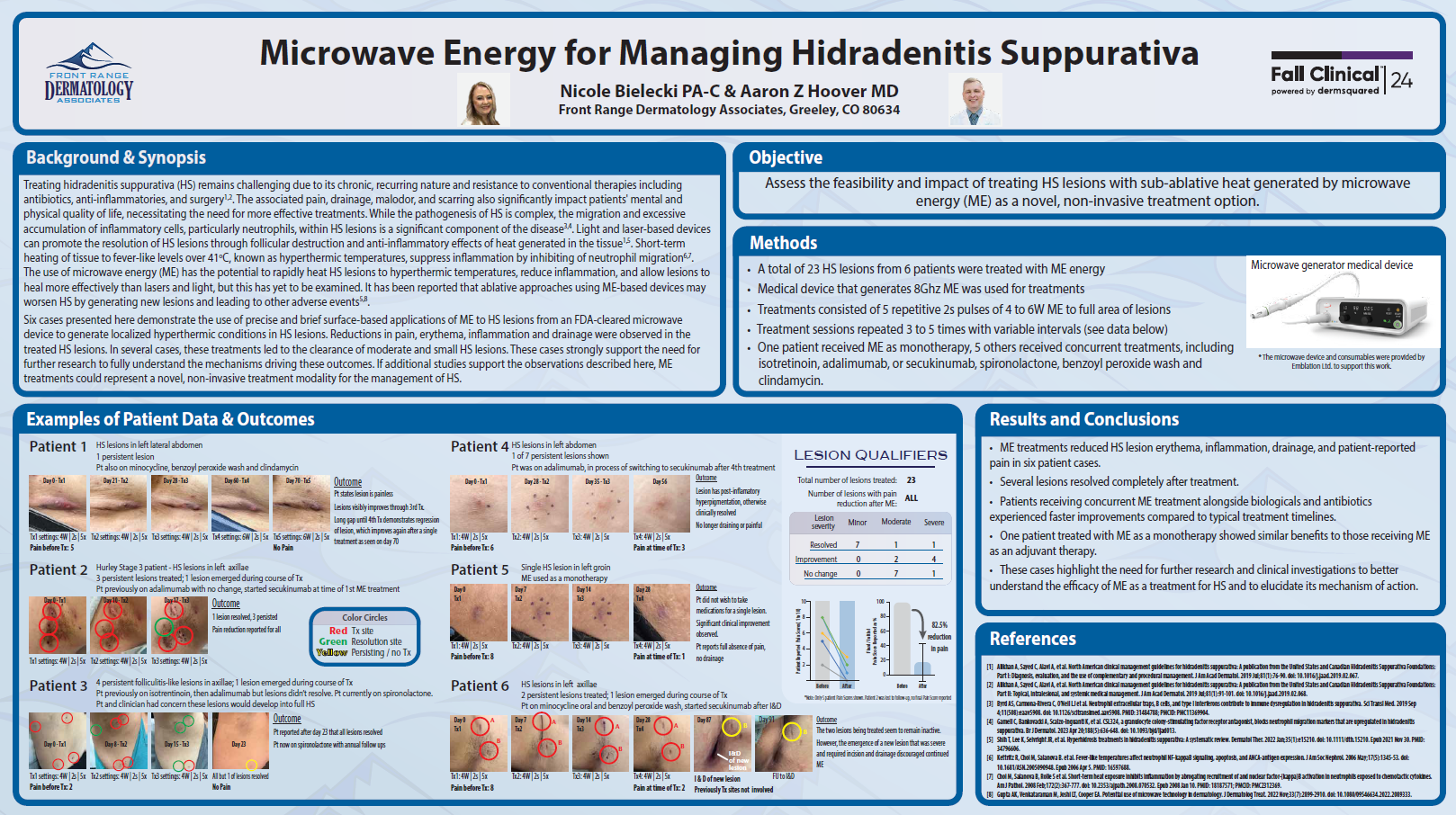
Microwave Energy for Managing Hidradenitis Suppurativa

Although still in the early days of feasibility work, this non-invasive, fast, well-tolerated and simple treatment of microwave energy shows promise as a novel modality for the management of HS.

ABSTRACT

Introduction:  Treating hidradenitis suppurativa (HS) is challenging due to its chronic, recurring nature and resistance to conventional therapies like antibiotics, anti-inflammatories, and surgery. Even with new biological treatments, there are challenges with injection site reactions. The associated pain, drainage, malodor, and scarring also significantly impact patients' mental well-being, underscoring the need for novel treatments. Four cases presented here suggest that microwave energy (ME) therapy can reduce pain, erythema and inflammation in HS lesions and even assist to resolve moderate and smaller lesions. Precise and brief surface-based applications of microwave energy to HS lesions from an FDA-cleared  microwave device intended for the coagulation of soft tissue were used to generate localized hyperthermic conditions in HS and pre-HS lesions. The rapid heating of the tissues led to subsequent clearance of moderate and small HS lesions. This was accompanied with a reduction in inflammation, draining and pain associated with these HS cases. While the outcomes are promising, the exact mechanism of action needs further investigation. These cases strongly support further research and demonstrate that ME holds promise as a novel, non-invasive treatment modality for the management of HS.

Procedure:  A total of 25 HS lesions from five patients were treated with ME energy. Five repetitive 2-second pulses of 3 to 4W of ME operating at 8GHz were applied to the full area of these lesions. Three to four treatment sessions were given ranging from 7 to 14 days apart.  Two patients received ME as a monotherapy, whereas the others began regimens of isotretinoin, adalimumab, or secukinumab at the same time as the first ME treatment.

Results:  These five patient cases demonstrate how ME treatments can lead to a rapid reduction in reported pain and erythema as well as clinical-assessed clearance of several early and moderate state HS lesions. Two of these patients only received ME as a monotherapy. However, based on clinical experience, even patients typically on medications will not typically show improvements within 7-14 days, suggesting that ME was having a rapid impact to manage pain and inflammation associated with HS lesions and in some cases assisting to resolve these lesions entirely.

Conclusions:  These cases report the first step in clinical feasibility and safety of microwave energy and shows promise as a novel modality for the management of HS. Although still in the early days of feasibility work, this non-invasive, fast, well-tolerated and simple treatment of microwave energy shows promise as a novel modality for the management of HS.

View poster here
View article here

Nicole Bielecki PA-C and Aaron Hoover MD, Presented at the Fall Clinical Dermatology Conference 2024


Research

Safety and efficacy of the swift microwave device in patients with mild‐to‐moderate onychomycosis: Protocol of an open‐label, randomized, dose‐finding pilot study

This study will be the first to report on the safety and efficacy of microwave treatment in onychomycosis patients in a trial setting.

Background: Onychomycosis is a common fungal nail disease with a prevalence rate up to 14% in North America and 24% in Europe. The current treatment paradigm is limited by a high risk of disease recurrence, safety concerns for oral agents, and a low likelihood of patients achieving both clinical improvement and mycological cure. Recent advances in device‐based treatments have allowed for the direct targeting of the infection site that bypasses drug resistance mechanisms while minimizing systemic side‐effects. The Swift® System is a microwave device that has demonstrated therapeutic potential in treating skin (e.g. verrucae vulgaris, actinic keratosis) and nail infections.

Methods: We report the protocol of an open‐label, randomized, pilot study that will be conducted at a single Canadian center. Our primary objective is to evaluate the safety and efficacy of microwave treatment (Swift® System, Emblation Ltd, Scotland, U.K.), administered at three different dosing regimens, in 45 patients with mild‐to‐moderate distal subungual onychomycosis. Our secondary objective is to identify an optimal dosing regimen, if any, to better inform the conduct of a future pivotal trial. Patients will be randomized (1:1:1) to undergo either 9 treatment sessions (5 weekly sessions plus 4 monthly sessions), 7 treatment sessions (3 sessions every 2 weeks plus 4 monthly sessions), or 12 treatment sessions every 2 weeks. At each session microwave energy will be applied in 3‐s intervals at 7– 9 Watts, repeated up to 5 times at each treatment position on the nail. Overlapping treatment positions are used to ensure sufficient coverage of the infected area. Patients will be enrolled in the trial over a 12‐month period. Efficacy will be evaluated based on visual improvement and mycology testing results. Adverse events will be recorded throughout the entire study period.

Discussion: This study will be the first to report on the safety and efficacy of microwave treatment in onychomycosis patients in a trial setting; recruitment is ongoing.

Trial registration: ClinicalTrials.gov, NCT05674747.

Read the full article
Aditya K. Gupta, Elizabeth A. Cooper, Tong Wang

Research

Successful Treatment of Diabetic Foot Ulceration with Concomitant Hyperkeratotic Hpv Infection Using Microwave Technology

This case report describes a patient who faced amputation due to the development of bilateral ulcerated hyperkeratotic verruca on the plantar surface.

Patients with diabetes who develop ulcers are ultimately often at risk of lower extremity surgical amputation if the wound cannot be managed and healed.

In the UK in 2023, more than 4.3 million people were reported to live with diabetes, although this figure is likely under-representative as an estimated 850,000 people remain undiagnosed. Worldwide, about 463 million people are reportedly diagnosed with diabetes, equating to almost 10% of the population based on a 2019 valuation.

This case report describes a patient who faced amputation due to the development of bilateral ulcerated hyperkeratotic verruca on the plantar surface. Over the course of nearly 5 years, traditional management strategies failed to resolve the lesions however treatment of the verrucae with microwave energy resulted in full resolution and complete healing of the ulcers on both feet. These outcomes significantly changed the patient’s life and may offer a therapeutic approach for patients with similar, stubborn HPV infected hyperkeratosis.

Read the full article
Tracy Davies, Colin Long