
Research

Microwave Energy for Treatment of Superficial and in situ Squamous Cell Carcinoma

Synopsis Localized, superficial microwave energy (ME) appears to have promise as a novel, rapid, and tolerated non-invasive approach to induce localized hyperthermic conditions for treating cutaneous non-melanoma skin cancers (NMSCs). Squamous cell carcinoma in situ (SCCis) is a very common NMSC appearing on sun exposed skin including the face. Standard treatments include excision or electrodessication and curettage, but other minimally ...

Synopsis

Localized, superficial microwave energy (ME) appears to have promise as a novel, rapid, and tolerated non-invasive approach to induce localized hyperthermic conditions for treating cutaneous non-melanoma skin cancers (NMSCs). Squamous cell carcinoma in situ (SCCis) is a very common NMSC appearing on sun exposed skin including the face. Standard treatments include excision or electrodessication and curettage, but other minimally invasive treatments are desirable, especially for areas with aesthetic importance, like the face, or regions that are slow to heal, such as the lower legs. Hyperthermia, a non-invasive treatment that raises tissue temperature above 43 degrees Celsius, has a long history in treating various cancers. Traditional hyperthermic treatments require warming large areas of tissue, but new technology now permits focused application of microwave energy (ME) to generate precisely targeted hyperthermic conditions in treated tissues. Literature suggests that localized hyperthermia increases tumor cell immunogenicity by activating stress response pathways in proliferative keratinocytes, promoting lesion clearance through innate and adaptive immune responses as well as apoptosis. Currently, both actinic keratoses (AKs) and human papillomavirus (HPV)-induced warts have been successfully treated with site-specific ME-induced hyperthermia. Given the higher incidence of SCCis in individuals with actinic damage and the evidence that ME can clear AK and hypertrophic AK (early stages in the squamous neoplasia continuum), increasing tumor immunogenicity via localized ME-induced hyperthermia may explain the observed clearance of cutaneous SCC (cSCC) lesions in the treated patients presented here. This feasibility work represents the first exploratory step in determining if ME-induced hyperthermia can serve as a novel, non-invasive treatment for NMSCs.

View poster here

View article here

Mark S. Nestor, Angelica Marrero-Perez, Aysham Chaudry and Robert Vanaria, Presented at the Fall Clinical Dermatology Conference 2024
Research

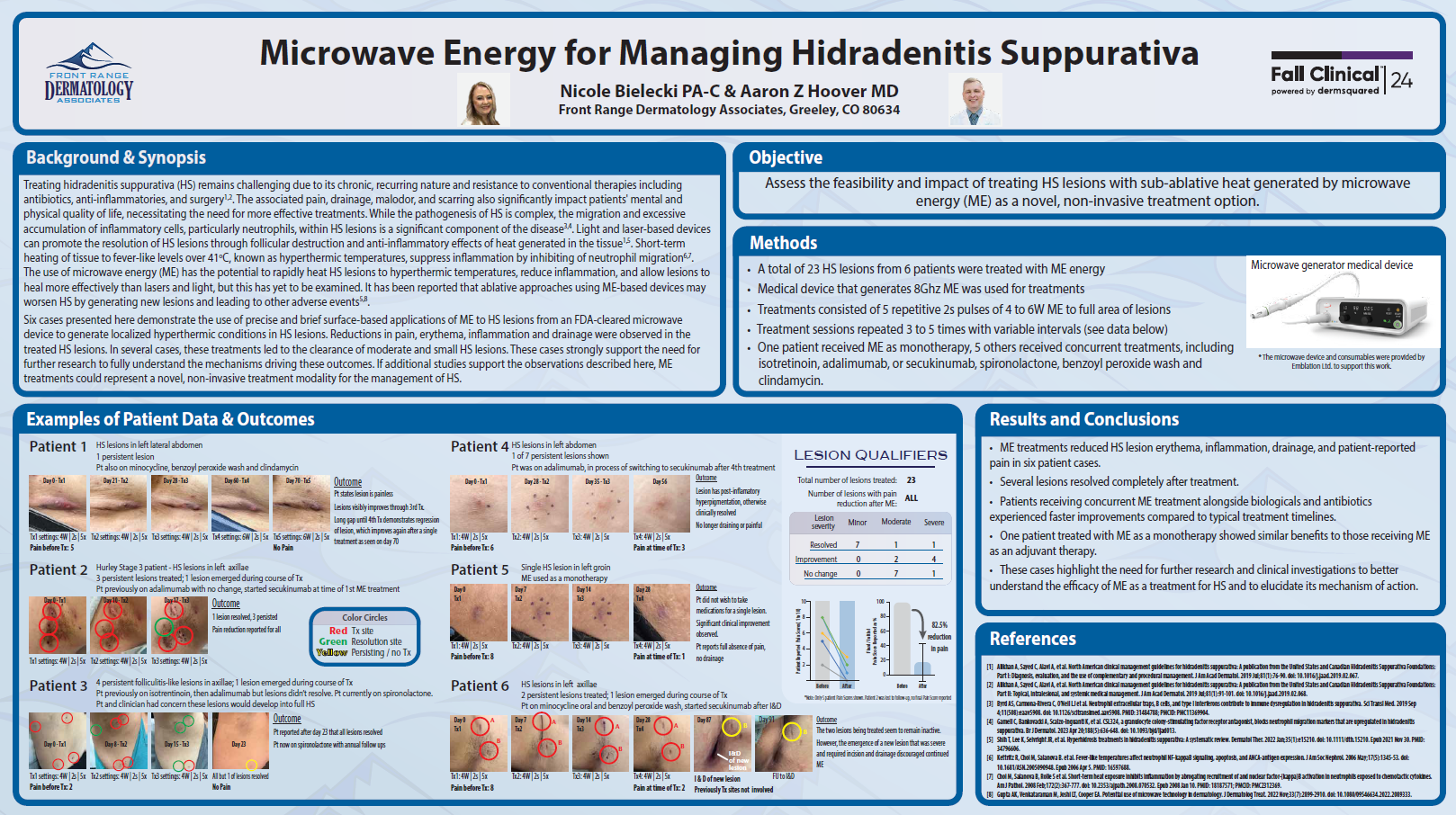
Microwave Energy for Managing Hidradenitis Suppurativa

Although still in the early days of feasibility work, this non-invasive, fast, well-tolerated and simple treatment of microwave energy shows promise as a novel modality for the management of HS.

ABSTRACT

Introduction:  Treating hidradenitis suppurativa (HS) is challenging due to its chronic, recurring nature and resistance to conventional therapies like antibiotics, anti-inflammatories, and surgery. Even with new biological treatments, there are challenges with injection site reactions. The associated pain, drainage, malodor, and scarring also significantly impact patients' mental well-being, underscoring the need for novel treatments. Four cases presented here suggest that microwave energy (ME) therapy can reduce pain, erythema and inflammation in HS lesions and even assist to resolve moderate and smaller lesions. Precise and brief surface-based applications of microwave energy to HS lesions from an FDA-cleared  microwave device intended for the coagulation of soft tissue were used to generate localized hyperthermic conditions in HS and pre-HS lesions. The rapid heating of the tissues led to subsequent clearance of moderate and small HS lesions. This was accompanied with a reduction in inflammation, draining and pain associated with these HS cases. While the outcomes are promising, the exact mechanism of action needs further investigation. These cases strongly support further research and demonstrate that ME holds promise as a novel, non-invasive treatment modality for the management of HS.

Procedure:  A total of 25 HS lesions from five patients were treated with ME energy. Five repetitive 2-second pulses of 3 to 4W of ME operating at 8GHz were applied to the full area of these lesions. Three to four treatment sessions were given ranging from 7 to 14 days apart.  Two patients received ME as a monotherapy, whereas the others began regimens of isotretinoin, adalimumab, or secukinumab at the same time as the first ME treatment.

Results:  These five patient cases demonstrate how ME treatments can lead to a rapid reduction in reported pain and erythema as well as clinical-assessed clearance of several early and moderate state HS lesions. Two of these patients only received ME as a monotherapy. However, based on clinical experience, even patients typically on medications will not typically show improvements within 7-14 days, suggesting that ME was having a rapid impact to manage pain and inflammation associated with HS lesions and in some cases assisting to resolve these lesions entirely.

Conclusions:  These cases report the first step in clinical feasibility and safety of microwave energy and shows promise as a novel modality for the management of HS. Although still in the early days of feasibility work, this non-invasive, fast, well-tolerated and simple treatment of microwave energy shows promise as a novel modality for the management of HS.

View poster here

View article here

Nicole Bielecki PA-C and Aaron Hoover MD, Presented at the Fall Clinical Dermatology Conference 2024

Research

Safety and efficacy of the swift microwave device in patients with mild‐to‐moderate onychomycosis: Protocol of an open‐label, randomized, dose‐finding pilot study

This study will be the first to report on the safety and efficacy of microwave treatment in onychomycosis patients in a trial setting.

Background: Onychomycosis is a common fungal nail disease with a prevalence rate up to 14% in North America and 24% in Europe. The current treatment paradigm is limited by a high risk of disease recurrence, safety concerns for oral agents, and a low likelihood of patients achieving both clinical improvement and mycological cure. Recent advances in device‐based treatments have allowed for the direct targeting of the infection site that bypasses drug resistance mechanisms while minimizing systemic side‐effects. The Swift® System is a microwave device that has demonstrated therapeutic potential in treating skin (e.g. verrucae vulgaris, actinic keratosis) and nail infections.

Methods: We report the protocol of an open‐label, randomized, pilot study that will be conducted at a single Canadian center. Our primary objective is to evaluate the safety and efficacy of microwave treatment (Swift® System, Emblation Ltd, Scotland, U.K.), administered at three different dosing regimens, in 45 patients with mild‐to‐moderate distal subungual onychomycosis. Our secondary objective is to identify an optimal dosing regimen, if any, to better inform the conduct of a future pivotal trial. Patients will be randomized (1:1:1) to undergo either 9 treatment sessions (5 weekly sessions plus 4 monthly sessions), 7 treatment sessions (3 sessions every 2 weeks plus 4 monthly sessions), or 12 treatment sessions every 2 weeks. At each session microwave energy will be applied in 3‐s intervals at 7– 9 Watts, repeated up to 5 times at each treatment position on the nail. Overlapping treatment positions are used to ensure sufficient coverage of the infected area. Patients will be enrolled in the trial over a 12‐month period. Efficacy will be evaluated based on visual improvement and mycology testing results. Adverse events will be recorded throughout the entire study period.

Discussion: This study will be the first to report on the safety and efficacy of microwave treatment in onychomycosis patients in a trial setting; recruitment is ongoing.

Trial registration: ClinicalTrials.gov, NCT05674747.

Read the full article
Aditya K. Gupta, Elizabeth A. Cooper, Tong Wang

Research

Successful Treatment of Diabetic Foot Ulceration with Concomitant Hyperkeratotic Hpv Infection Using Microwave Technology

This case report describes a patient who faced amputation due to the development of bilateral ulcerated hyperkeratotic verruca on the plantar surface.

Patients with diabetes who develop ulcers are ultimately often at risk of lower extremity surgical amputation if the wound cannot be managed and healed.

In the UK in 2023, more than 4.3 million people were reported to live with diabetes, although this figure is likely under-representative as an estimated 850,000 people remain undiagnosed. Worldwide, about 463 million people are reportedly diagnosed with diabetes, equating to almost 10% of the population based on a 2019 valuation.

This case report describes a patient who faced amputation due to the development of bilateral ulcerated hyperkeratotic verruca on the plantar surface. Over the course of nearly 5 years, traditional management strategies failed to resolve the lesions however treatment of the verrucae with microwave energy resulted in full resolution and complete healing of the ulcers on both feet. These outcomes significantly changed the patient’s life and may offer a therapeutic approach for patients with similar, stubborn HPV infected hyperkeratosis.

Read the full article
Tracy Davies, Colin Long

Research

Microwave Energy for the Treatment of Painful Intractable Plantar Keratosis: A Retrospective Medical Record Review of Nine Patients

Concluding the use of microwave therapy has been shown to be effective in producing significant and prolonged pain reduction in a cohort of patients with painful IPK.

Plantar keratoma are common hyperkeratinized, deep-seated lesions, often located on weightbearing areas of the foot. Such lesions are frequently associated with pain and disability. Intractable plantar keratomata (IPK) are highly recurrent and, in most patients, require regular, palliative treatment visits with a significant impact on patient time, cost, and quality of life.

This article is a retrospective chart review of 9 patients (with a total of 21 lesions) who underwent a minimum of two treatments using microwave therapy to their IPK. Pain levels were assessed at each of their treatments using a 10-point scale and patients were invited for review for follow-up in the following year. A total of seven patients undertook four treatments and were included in the final analysis.

Mean baseline pain scores significantly dropped with each subsequent treatment, equating to a 90.4% mean reduction in pain between the first and fourth visits, with 71.4% of patients reporting a zero-pain rating at their final treatment visit. Concluding the use of microwave therapy has been shown to be effective in producing significant and prolonged pain reduction in a cohort of patients with painful IPK.

Read the full article
Ivan R. Bristow, Raphael Lilker

Research

New option in wart therapy / Neue Option in der Warzentherapie

"The use of microwaves in the treatment of long-standing and particularly stubborn warts represents a valuable addition to the therapeutic toolkit. The good response rates not only create satisfied patients, but also become a positive experience for the therapist."

Since the beginning of this year, we have also been able to treat warts using microwaves. We are happy to be able to offer our patients who do not respond adequately to conventional therapy another treatment option.

Keypoints

  • Immunomodulatory hyperthermia procedure, which is particularly recommended for therapy-resistant warts.
  • Particularly suitable for children, active adults and patients with limited mobility as it is less complex to use and no soaking or scraping is required.
  • Although it can be combined with other treatments, treatment on softened calluses is more painful and is not recommended. After treatment, walking without pain is often possible quickly.
  • The short duration of a session makes it easier to integrate into everyday practice without additional equipment and can be delegated.

----------------------------------------

"Die Anwendung der Mikrowelle in der Behandlung von langbestehenden und besonders hartnäckigen Warzen stellt eine wertvolle Erweiterung des therapeutischen Instrumentariums dar. Die guten Ansprechraten schaffen nicht nur zufriedene Patienten, sondern werden auch zu einer positiven Erfahrung für den Therapeuten."

Seit Anfang dieses Jahres besteht auch bei uns die Möglichkeit, die Warzen mittels Mikrowelle behandeln zu lassen. Wir sind froh, unseren Patienten, welche auf die konventionelle Therapie nur unzureichend ansprechen,eine weitere Therapiemöglichkeit anbieten zu können.

Keypoints

  • Immunmodulatorisches Hyperthermie-Verfahren, das besonders bei therapieresistenten Verrucae empfohlen wird.
  • Besonders geeignet für Kinder, aktive Erwachsene und bewegungseingeschränkte Patienten, da weniger aufwendig in der Anwendung und kein Einweichen oder Abschaben erforderlich.
  • Obwohl grundsätzlich mit anderen Mitteln kombinierbar, ist die Behandlung auf aufgeweichter Hornhaut schmerzhafter und nicht empfohlen. Nach der Behandlung ist ein schmerzfreies Gehen oft schnell möglich.
  • Die kurze Dauer einer Sitzung erleichtert die Integration in den Praxisalltag ohne zusätzliches Equipment und kann delegiert werden.

Read the full article [German]
Helena Odermatt, Bettina Rümmelein

Research

Treating Actinic Keratosis using Swift microwave therapy

An 11-patient trial was carried out by the University of Dundee to evaluate the efficacy and feasibility of microwaves as a treatment for Actinic Keratosis (AK). 90% of treated AKs resolved 120 days post treatment, with 78% resolving after one week.

Feasibility Study for Feasibility Study for Precancerous Actinic Keratosis (AK)

90% Treated AK resolved 120 days post treatment.

An 11-patient trial was carried out by the University of Dundee to evaluate the efficacy and feasibility of microwaves as a treatment for Actinic Keratosis (AK). 90% of treated AKs resolved 120 days post treatment, with 78% resolving after one week.

The early findings in this small cohort of patients delivered promising results for the effectiveness of Swift® microwave therapy in treating AK and we are currently investing in a multi-center, open, randomized, controlled, blind-assessed trial of approximately 60 subjects to fully examine the impact of Swift® on this indication (NCT05371834).

https://onlinelibrary.wiley.com/doi/10.1111/bjd.18935

What is Actinic Keratosis?

Actinic keratosis (AK) is a common skin condition characterised by the development of rough, scaly patches or lesions on the skin. It is caused by long-term exposure to ultraviolet (UV) radiation from the sun or artificial sources like tanning beds. AK typically affects areas of the skin that are frequently exposed to the sun, such as the face, scalp, ears, neck, arms, and hands. The condition usually appears as small, dry, or rough patches with a flat or slightly raised surface.

Actinic keratosis is considered a precancerous condition because it has the potential to develop into squamous cell carcinoma, a type of skin cancer. However, not all actinic keratoses progress to cancer, and it is difficult to predict which ones will.

Current treatments for Actinic Keratosis

  • Topical Medications: Prescription creams or gels containing ingredients like imiquimod, fluorouracil, or diclofenac can be applied to the affected areas to destroy the abnormal cells.
  • Cryotherapy: Liquid nitrogen is used to freeze and destroy the lesions.
  • Curettage and Electrodessication: The lesions are scraped off with a curette and then an electric current is used to destroy any remaining abnormal cells.
  • Photodynamic Therapy: A photosensitising agent is applied to the lesions, followed by exposure to a specific type of light that activates the medication and destroys the abnormal cells.
  • Laser Therapy: Laser beams are used to selectively target and destroy the lesions.

Research

Utility of devices for onychomycosis: a review

Onychomycosis is a hard-to-treat fungal infection of the nail unit; high complete cure and mycological cure rates remain elusive.

Many oral and topical antifungal agents are approved by regulatory bodies around the world for the treatment of onychomycosis including terbinafine, itraconazole, 10% efinaconazole, 5% tavaborole, and 8% ciclopirox. These agents have varying rates of success in clinical studies, with limitations such as long treatment durations, drug interactions, low patient compliance, and high relapse rates.

Device-based treatments are targeted to specific regions of the nail, have favorable safely profiles, and do not interfere with systemic agents. They may be an effective alternative therapy for onychomycosis especially with increasing reports of squalene epoxidase gene mutations and potential resistance to terbinafine therapy.

This review discusses four devices used as antifungal treatments and three devices used as penetration enhancers for topical agents. Lasers, photodynamic therapy, microwaves, and non-thermal plasma have the capacity to inactivate fungal pathogens demonstrated through in vivo studies.

Read the full article

Aditya K. Gupta, Shruthi Polla Ravi, Sandor Haas-Neill, Tong Wang & Elizabeth A. Cooper

Research

Microwave Energy as a Treatment for Onychomycosis

Onychomycosis, commonly known as fungal nail, affects up to 50% of older individuals

Background

• Onychomycosis, commonly known as fungal nail, affects up to 50% of older individuals.
• Onychomycosis is challenging to treat for several reasons:
- Dermatophytes are embedded in and/or under the nail plate.
- Many treatment approaches are used, but all, including oral medications, have widely varying clearance rates.
- Resistance to oral medications is growing globally.
- Nail regrowth is slow and requires on-going management of both infection and lifestyle.
• Growing anti-fungal drug resistance highlights the need for novel treatments with unique mechanisms of action.
• Heat and microwaves can kill T. rubrum, the most prevalent dermatophyte, in clothing and footwear.

Summary

• All cases showed visual improvement.
• Treatment with the microwave device was relatively easy and offers several benefits.

View poster here

Robert Conenello, Presented at the TPMA Annual Scientific Conference 2023

Research

Clinical trials to crack embarrassing nail disease

We are undertaking a rigorous clinical trial to eradicate an embarrassing condition which disfigures and deforms toenails. The unsightly condition affects millions of sufferers and is notoriously difficult to treat, but our ground breaking microwave treatments could prove effective.

Sufferers are left with thickened, rough and yellowed nails which are brittle and prone to breaking off. Sometimes entire nails lift off causing pain and swelling in the skin around the nail. In extreme cases patients have to undergo surgery to remove their toenails.

Our innovative Swift® device is already a global success in treating stubborn common and plantar warts and will now feature in a medical pilot study involving patients with onychomycosis.

The pilot study will follow 45 patients with onychomycosis who will each undergo 12 months of treatment. It will be led by Dr Aditya K Gupta, he is one of the world’s foremost experts on the fungal nail condition.

Dr Matt Kidd, Director of Research and Development, said: “It is early in the process, but we are thrilled to have a formal pilot study underway and to have such an eminent expert as Dr Gupta to lead it.

“Any effective new treatment for this persistent and unsightly condition will be welcomed by both patients and clinicians, who have too few options available to them.

“All medical research is rightly very demanding and assessed at every stage, so there is some way to go before we have results, but we are all very excited about the possibilities.”

Dr Gupta is an extensively published expert in fungal skin infections and a renowned dermatologist in Canada and, where he runs a dedicated dermatology research facility. He said the results would be eagerly awaited by many sufferers.

He added: “Onychomycosis is a pervasive and difficult condition to treat. Fungal nail infections can be unsightly in appearance, cause embarrassment, disrupt daily activities, and have a negative psychosocial connotation including low self-esteem, and social withdrawal.

“This is a condition with a large unmet medical need. We welcome Emblation in supporting our pilot investigational study as these patients presently have few effective treatment options.”

It is estimated that up to 12% of the population suffer from the toenail condition. While some do not even notice the condition, many seek treatment on cosmetic grounds however, others end up with severely damaged and deformed toenails. The condition usually affects the nail of the big toe, but can affect others and can even spread to finger nails

Treatments typically involve applying antifungal creams or lacquers multiple times a day for up to 12 months with patchy results. Concerns are growing in the medical community that newer strains of the condition have developed a resistance the anti-fungal creams and drugs most often used in treatment.

The idea of using Swift to treat the toenail condition evolved from discussions with our podiatrists and other consultants who have been successful in using the technology to treat other conditions.

Dr Kidd from Emblation said: “We also did some early work with the University of Plymouth where we cultivated the fungus in a laboratory environment and treated it with microwaves with successful results, giving us confidence that we are on the right path.”

Taking place in London, Ontario, the pilot study (registered as NCT05674747) will see 45 patients randomly split into three groups of 15. Group A will receive treatment weekly in the first month, then monthly for four months (nine treatments).

Group B will get fortnightly treatments in the first month followed by monthly treatment for four months (seven treatments), while Group C will get treatment every two weeks for six months (12 treatments).

Those who do not achieve results which match efficacy levels by month six or nine will be offered further monthly treatments. All patients will be monitored for 12 months, with the goal of finding the optimum regimen dosage of Swift.

Emblation was established by Gary Beale and Eamon McErlean, who met during their postgraduate studies in Edinburgh. In 2016, they made an innovative contribution to the podiatry sector by launching Swift®, which has gone from strength to strength since.

At Emblation, we aim to create and promote reliable and accessible medical microwave systems for use in dermatology, podiatry, and oncology.

Study NCT05674747 has been approved by Health Canada for Principal Investigator:  Aditya Gupta, MD,PhD,  Mediprobe Research Inc.